Starting IB

What Is IB Chemistry? SL vs HL Explained for Students and Parents

Understand IB Chemistry SL vs HL, the Structure and Reactivity syllabus, assessment, workload and how students and parents can choose the right level.

Read in Vietnamese
Students in a classroom discussing academic course choices.
Choosing between SL and HL is a decision about goals, readiness and workload—not prestige.

The difference is not simply “less Chemistry” versus “more Chemistry”. SL is already a complete conceptual, quantitative and experimental course. HL takes that foundation further: students meet more content, make more connections between topics and solve longer problems in less familiar contexts.

If a family remembers only one principle, it should be this:

Choose HL because the student needs or genuinely wants deeper Chemistry—not because the letters “HL” appear more impressive.

The real decision is not “easy or difficult?”

Two students can receive the same Chemistry grade and still need different levels.

One may be considering Chemistry, medicinal chemistry, pharmacy or another university route for which Chemistry HL could be required or academically important. The other may be heading towards a field that does not need advanced Chemistry and may benefit more from using an HL position for Mathematics, Biology, Physics, Economics or another strategic subject.

Both students may enjoy Chemistry. Both may be capable. Yet the right decision can still be different.

That is why the most useful question is not:

“Which level looks better?”

It is:

“Which level serves the student’s real goals without weakening the rest of the Diploma?”

Students do not need to have their entire career fixed at the age of 15 or 16. Parents do not need to understand every equation in the course. But the family does need an honest picture of three things:

  1. what each level asks the student to do;
  2. which university options may depend on the choice;
  3. whether the student can sustain that choice alongside the rest of IB.

The aim is not to construct the most difficult-looking subject combination. It is to construct the right one.

IB Chemistry SL and HL at a glance

FeatureStandard Level (SL)Higher Level (HL)
Recommended teaching time150 hours240 hours
Syllabus content110 hours180 hours
Experimental programme40 hours60 hours
External assessment80%80%
Scientific Investigation20%20%
Paper 11 hour 30 minutes2 hours
Paper 21 hour 30 minutes2 hours 30 minutes
Nature of the courseComplete conceptual, quantitative and experimental Chemistry courseThe same framework with additional content and greater depth
Typical challengeApplying familiar Chemistry in unfamiliar questionsConnecting several ideas through longer, less familiar problems
Strategic purposeChemistry without unnecessary advanced depthPreparation for routes that require or benefit from deeper Chemistry

The 90-hour difference in recommended teaching time matters, but it does not tell the whole story. HL is also different in the kind of thinking expected. Later questions can require students to combine ideas that they may have first met separately: bonding with energetics, stoichiometry with equilibrium, or organic mechanisms with analytical evidence.

The table above is a decision aid, not an admissions rule. University requirements vary by institution, course, country and admission year. If the level choice is being made for university reasons, use the detailed guide to choosing Chemistry SL or HL for university and verify every important requirement on the university’s official course page.

Comparison of recommended teaching hours, syllabus content and experimental work in IB Chemistry SL and HL.
HL extends the same framework; it is not a completely separate Chemistry course.

What do students actually study?

The current course is organised around Structure and Reactivity. These are not merely two headings used to divide a textbook. Together, they reflect how chemists explain matter and chemical change.

Structure: what matter is and why it behaves as it does

Structure asks questions such as:

  • What is matter made of?
  • How are electrons and particles arranged?
  • Why do atoms form bonds?
  • Why does one substance conduct electricity while another does not?
  • Why can two molecules with similar masses have very different boiling points?
  • How does molecular structure affect physical properties and chemical behaviour?

The three broad groups are:

  1. models of the particulate nature of matter;
  2. models of bonding and structure;
  3. classification of matter.

Students still meet familiar Chemistry such as atomic structure, the mole, bonding, periodicity, functional groups and the relationship between structure and properties. The important difference is that these ideas are treated as connected models rather than isolated facts.

Reactivity: why and how chemical change occurs

Reactivity asks:

  • Why does a reaction occur?
  • How much product can form?
  • What controls the rate of a reaction?
  • How far will a reaction proceed before reaching equilibrium?
  • How are protons or electrons transferred?
  • How can the movement of electron pairs explain an organic mechanism?

Its three broad groups are:

  1. what drives chemical reactions;
  2. how much, how fast and how far;
  3. the mechanisms of chemical change.

Structure and Reactivity are therefore not independent halves of the course. Structure helps explain properties; properties influence reactivity; experimental evidence tests whether the model is useful.

A question about intermolecular forces may begin with molecular structure and end with boiling-point data. A rate question may combine particle collisions, energetics and interpretation of a graph. An equilibrium calculation may require a balanced equation, stoichiometry and algebra before the student can explain what the final value means chemically.

This is also why revising the course as a collection of sealed “chapter boxes” becomes less effective as examinations approach. Students must be able to move between ideas.

Concept map connecting particles, bonding and classification with reaction drivers, rate, extent and mechanisms.
Students are expected to connect structure, properties, reactivity and experimental evidence.

SL is not the “easy” version of Chemistry

At SL, students still calculate, analyse unfamiliar data, evaluate experiments and write precise scientific explanations.

A common frustration is:

“I understand the Chemistry, but I still lose marks.”

Sometimes the student does understand the general idea. The marks disappear because the answer does not yet show the complete chain of reasoning. Strong SL performance usually depends on four abilities.

1. Explain the Chemistry, not only remember the conclusion

Knowing that a boiling point increases is not enough when the question asks why.

The explanation may need to connect molecular size or structure to polarizability, intermolecular forces and the energy required to separate molecules. A statement can point in the right direction and still stop one reasoning step too early.

This pattern appears throughout the course:

  • electron arrangement → periodic behaviour;
  • bonding and structure → physical properties;
  • collisions and activation energy → reaction rate;
  • molecular structure → organic reactivity;
  • experimental evidence → support for or limitation of a model.

The arrow matters. It represents the reasoning that earns the mark.

2. Set a calculation up correctly

SL regularly uses:

  • amount of substance and the mole;
  • molar mass;
  • balanced equations;
  • stoichiometric ratios;
  • limiting reactants;
  • concentration;
  • gases;
  • energetics;
  • kinetics;
  • equilibrium;
  • acid–base calculations.

The arithmetic is often not the hardest part. The difficult question is:

“Which quantity should I begin with, and which chemical relationship connects it to what I need?”

A student who memorises isolated formulas may cope with familiar exercises but become stuck when the same Chemistry is presented in a different order or context.

3. Work with data they have never seen before

Paper 1B and Paper 2 can place familiar Chemistry inside an unfamiliar situation. Students may meet:

  • a new graph;
  • an unfamiliar experimental arrangement;
  • a table of primary or secondary data;
  • an anomaly in an otherwise clear trend;
  • uncertainty information;
  • an unfamiliar molecule or reaction.

The examination is not asking whether the student recognises the page of notes. It is asking whether the student can use Chemistry as a tool.

4. Write explanations with sufficient precision

Consider the statement:

“The rate increases because there are more collisions.”

That may be relevant, but it may not be complete. Depending on the question, the student may need to explain why collision frequency changes, why a greater proportion of particles has sufficient energy, or how the number of successful collisions per unit time is affected.

One missing reasoning step can be one missing mark.

SL reduces the breadth and depth relative to HL. It does not remove the need for serious scientific thinking.

Success at SL requires more than remembering content

Explain

Connect an observation or trend to an appropriate chemical reason.

Set up

Choose the correct starting quantity, relationship and sequence of steps.

Interpret

Use unfamiliar graphs, data and experimental evidence.

Communicate

Show every necessary reasoning step with precise scientific language.

Understanding must become visible in the answer.

SL is a complete Chemistry course with conceptual, quantitative, experimental and communication demands.

What does HL add?

HL is not simply SL plus a few additional chapters.

It adds content, but it also changes how far students are expected to take an idea and how readily they must connect several ideas within one problem.

More content

At HL, students go further in areas such as:

  • atomic and electronic structure;
  • bonding, structure and delocalisation;
  • periodic chemistry;
  • energetics, entropy and spontaneity;
  • kinetics;
  • equilibrium;
  • acid–base chemistry;
  • redox and electrochemistry;
  • organic mechanisms and synthesis;
  • chemical analysis.

The exact challenge is not identical in every topic. Some areas contain additional models or relationships. Others require more sophisticated quantitative treatment or more detailed mechanistic reasoning.

Deeper conceptual links

An HL student needs more than a larger collection of facts. The student must understand why a model is useful, how it relates to evidence and where its limitations may lie.

For example, a question may move from electron configuration to periodic behaviour, then to bonding and finally to an observed property. If the knowledge exists only as four separate note pages, the student may know every individual fact and still fail to build the answer.

Longer quantitative reasoning

An HL calculation may ask the student to:

  1. identify the relevant chemical model;
  2. build or interpret an equation;
  3. connect several pieces of information;
  4. use algebra across multiple steps;
  5. check units and assumptions;
  6. interpret the numerical answer chemically.

The course is not Mathematics HL in disguise. However, avoiding algebra or proportional reasoning can become a serious obstacle.

Greater integration in unfamiliar problems

Imagine that the examination provides an unfamiliar organic molecule and a sequence of reactions.

A student relying mainly on memorised reaction maps may search for an example that “looks the same” as something in their notes. A stronger approach is to:

  1. identify the functional groups;
  2. locate electron-rich and electron-poor regions;
  3. identify the reacting species;
  4. follow electron-pair movement;
  5. apply the stated reaction conditions;
  6. check whether the proposed product fits the analytical evidence.

The same integration appears in physical Chemistry. An equilibrium problem may combine a balanced equation, initial amounts, equilibrium change, an equilibrium expression and algebra before asking what the result means.

This is where HL often exposes an insecure foundation. Weaknesses in moles, equations, bonding or algebra do not remain confined to the chapter in which they first appeared. They reappear inside more complex questions.

That does not mean a student must be “naturally brilliant at Chemistry” before beginning HL. It means gaps should be identified and repaired early, while there is still time to build on them.

Why HL feels harder

HL-level reasoning
More content
Deeper conceptual links
Longer multi-step calculations
More topics combined in one unfamiliar problem
Secure SL foundations

The main difficulty is often integration—not one individual chapter.

HL difficulty accumulates: additional content rests on foundations that must already be reliable.

How is IB Chemistry assessed?

SL and HL use the same assessment weighting:

  • 80% external assessment;
  • 20% Scientific Investigation.

The examination papers are longer at HL, but the percentage contribution of each component remains the same.

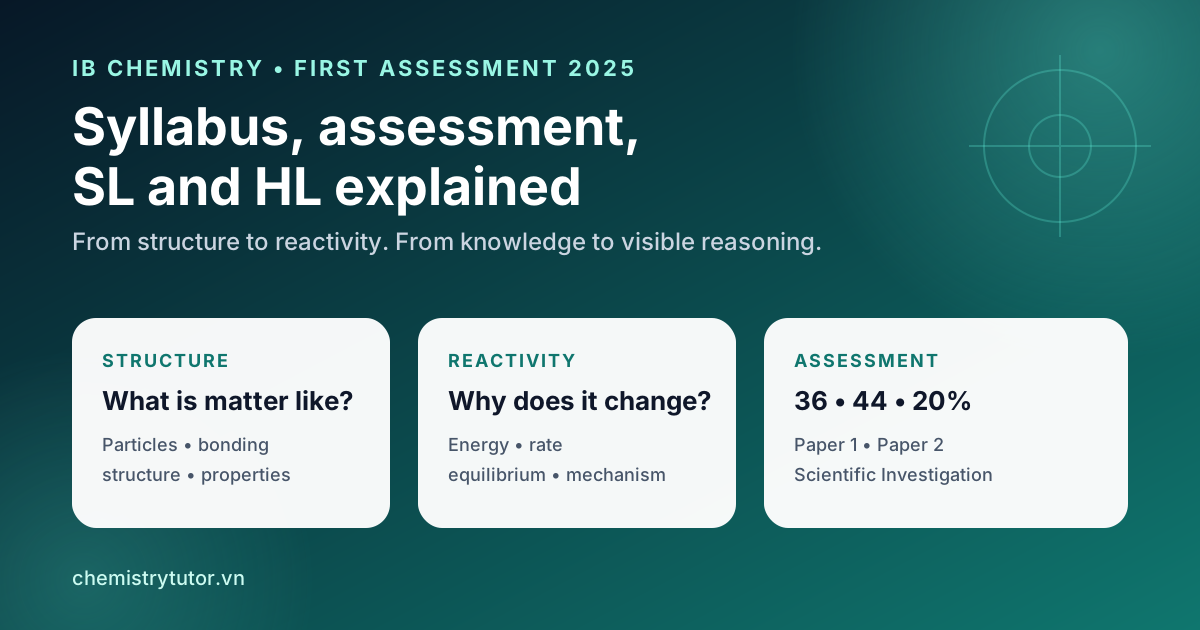
IB Chemistry assessment comprises Paper 1 at 36%, Paper 2 at 44% and a Scientific Investigation at 20%.
Both levels use the same assessment weighting, but HL examinations are longer.

Paper 1 — 36%

Paper 1 contains:

  • Paper 1A: multiple-choice questions;
  • Paper 1B: data-based questions and questions on experimental work.

Total time:

  • SL: 1 hour 30 minutes;
  • HL: 2 hours.

Paper 1A rewards secure knowledge, careful discrimination between similar options and efficient problem solving. Paper 1B requires students to interpret evidence, work with data and think about experimental procedures. These are related but distinct skill sets.

Paper 2 — 44%

Paper 2 contains short-answer and extended-response questions.

Total time:

  • SL: 1 hour 30 minutes;
  • HL: 2 hours 30 minutes.

Students need to make their reasoning visible. Correct answers without a defensible method may not show the evidence required for all available marks.

Scientific Investigation — 20%

Both SL and HL students complete an individual Scientific Investigation.

The student develops a research question, gathers and analyses data, and presents an evidence-based conclusion and evaluation. The maximum overall report length is 3,000 words.

The investigation is not simply a long laboratory report. A strong investigation depends on a focused and feasible question, useful quantitative data, sound Chemistry and an evaluation that responds honestly to the evidence.

For the complete process, see the IB Chemistry Scientific Investigation guide. For paper-specific revision, see how to prepare for Paper 1A, Paper 1B and Paper 2.

Is HL better than SL?

No.

HL is a higher level of study, but that does not make it the best choice for every student.

If a student is considering a Chemistry-intensive degree, HL may be required or may provide much more appropriate preparation. In that situation, the additional workload can serve a clear purpose.

If likely university routes do not need advanced Chemistry, SL may be the stronger strategic choice—especially when another subject needs to occupy one of the limited HL positions.

There is also an opportunity cost. Every additional hour spent keeping up with an unnecessary HL course is an hour that cannot be used for another subject, the Extended Essay, TOK, CAS, university applications, rest or life outside school.

A student may be individually capable of studying Chemistry HL, Physics HL and Mathematics AA HL. That does not automatically mean the combination is sustainable alongside three other subjects and the Diploma core.

The useful question is therefore:

Does Chemistry HL support a real goal strongly enough to justify its place in the student’s complete programme?

Who may be better suited to SL or HL?

No checklist can make the decision automatically, but the following patterns are useful.

SL may be appropriate when the student:

  • wants to study Chemistry seriously but probably does not need advanced Chemistry for university;
  • already has other strategically important HL subjects;
  • enjoys Chemistry but does not intend to specialise in it;
  • needs to keep the overall Diploma workload balanced;
  • can meet likely university requirements with Chemistry SL;
  • would benefit more from securing excellent foundations than from adding unnecessary depth.

SL still requires consistent work. It simply offers a scope and depth designed for a different academic purpose.

HL deserves serious consideration when the student:

  • may apply for a degree that requires or strongly benefits from advanced Chemistry;
  • has checked several realistic university courses rather than relying on general advice;
  • enjoys quantitative science;
  • is reasonably comfortable with basic algebra and proportional reasoning;
  • wants to understand mechanisms and causes rather than mainly remember outcomes;
  • is prepared to practise throughout the two years;
  • can include Chemistry HL without making the rest of the Diploma unsustainable.

The student does not need to be outstanding in every area on the first day. A relevant weakness can often be improved. The key is to identify it accurately and build a realistic plan.

Do not make the final decision yet when:

  • the student’s possible university direction remains very unclear;
  • current grades do not reveal why Chemistry is difficult;
  • there may be repairable gaps in moles, equations, algebra or scientific English;
  • the other HL choices have not been considered together;
  • the decision is being driven mainly by prestige, comparison with classmates or fear that SL will “look weak”.

Uncertainty is not a reason to panic. It is a reason to gather better information.

A practical SL or HL decision path

Could a realistic university course require or strongly prefer Chemistry HL?

Yes

Check current official course requirements.

Can the student build the necessary foundation and carry the total Diploma workload?

Yes

HL deserves serious consideration.

Not yet

Strengthen the foundation and seek guidance before deciding.

No or unsure

Would HL serve a genuine academic interest or be one of the student’s strongest HL choices?

Yes

Compare it with the other HL options and the total Diploma workload.

No

SL may be the more strategic choice.

University requirements come first, followed by readiness, workload and genuine academic interest.

A student self-check

If you are the student, ask yourself:

Can I explain an idea rather than only remember the answer?

Remembering that a periodic trend moves in a particular direction is not the same as explaining it through nuclear charge, shielding and distance.

When I meet an unfamiliar calculation, can I identify what the question wants?

If you regularly do not know where to begin, the problem may be stoichiometric reasoning or algebra—not a lack of “Chemistry talent”.

Can I use ratios and rearrange basic equations with reasonable confidence?

HL Chemistry is not a Mathematics course, but quantitative avoidance becomes costly. The mathematics can be improved, but it should not be ignored.

Can I interpret an unfamiliar graph or data table without immediately becoming lost?

You do not need to recognise the context. You need to identify variables, trends, anomalies and chemically meaningful relationships.

Am I interested enough to stay with a difficult problem?

Interest does not replace practice. It makes sustained practice more realistic.

Am I prepared to work consistently for two years?

HL is much easier to manage through steady practice than through repeated emergency revision.

What can parents observe without knowing Chemistry?

Parents do not need to solve equilibrium calculations or recognise an organic mechanism. More useful observations include:

  • Can your child explain a topic in their own words?
  • Are calculation errors caused by arithmetic, or by not knowing where to begin?
  • Does the same error return after feedback?
  • How does your child respond to an unfamiliar graph or experimental question?
  • Is the difficulty mainly Chemistry, mathematics, scientific English or organisation?
  • Is Chemistry beginning to consume time needed by the rest of the Diploma?
  • Is HL supporting a real goal, or does it simply appear more prestigious?

One test grade does not answer these questions. A pattern across several weeks is more informative.

A student with a temporarily low grade may have strong reasoning and a specific gap that can be repaired. A student with a high grade may still rely heavily on familiar question types and struggle when the context changes. The diagnosis matters more than the label “strong” or “weak”.

Two perspectives. One decision.

Student

  • Can I explain ideas rather than only remember answers?
  • Can I find a route through an unfamiliar calculation?
  • Can I use algebra and ratios with reasonable confidence?
  • Can I interpret unfamiliar graphs and data?
  • Will I practise consistently for two years?

Parent

  • Can my child explain a topic in their own words?
  • Do repeated errors improve after feedback?
  • Is the difficulty Chemistry, Mathematics, scientific English or organisation?
  • Is Chemistry taking too much time from the rest of the Diploma?
  • Is HL serving a real goal?

Look for patterns across several weeks—not one test grade.

Before making the final decision

A family does not need to research fifty universities. It does need enough real examples to identify a pattern.

Try this process:

  1. List three university directions the student could realistically consider.
  2. Select two or three possible universities or courses for each direction.
  3. Record the current subject and level requirements from each official course page.
  4. Highlight any subject that appears repeatedly.
  5. Compare those requirements with the student’s foundation, other HL subjects and complete workload.

This exercise often makes the decision clearer. Chemistry HL may appear repeatedly as necessary or valuable. It may also turn out to add little to the student’s likely routes. Both findings are useful.

The International Baccalaureate’s own course-selection guidance encourages students to consult counsellors and check admission requirements with individual universities. Requirements can vary even between degrees with similar names, and they can change between admission cycles.

Frequently asked questions

Is IB Chemistry HL much harder than SL?

HL has 240 recommended teaching hours compared with 150 at SL. It includes additional content and expects greater conceptual depth, longer quantitative reasoning and more integration between topics. How large the difference feels depends strongly on the student’s foundation. Weaknesses in moles, equations, bonding or algebra tend to become much more visible in later HL work.

Is IB Chemistry SL easy?

No. SL is a complete Chemistry course. Students still need to calculate, interpret data, reason about experiments, apply ideas in unfamiliar situations and communicate explanations precisely. It has less content and depth than HL, but it should not be treated as a course that can be passed through memorisation alone.

Does Chemistry HL always look better to universities?

No. Universities are interested in whether applicants meet the correct prerequisites and achieve the required overall and HL scores. An unnecessary HL that reduces performance across the Diploma is not automatically advantageous. The strongest combination is the one that meets entry requirements and allows the student to perform well.

Is Chemistry HL compulsory for Medicine?

There is no universal answer. Requirements vary by medical school, country and admission cycle. Some programmes specify Chemistry at HL; others require a particular combination of sciences or accept different routes. If Medicine is a serious possibility, check a realistic group of medical schools directly before finalising the subject combination.

How much Mathematics is used in Chemistry HL?

Chemistry HL is not a Mathematics course, but students regularly use ratios, equation rearrangement, proportional reasoning, logarithmic relationships, graphs and multi-step calculations. Students do not need to love every part of Mathematics, but they should be willing to repair weak algebra rather than continually avoid quantitative questions.

Can a student move from HL to SL later?

This depends on the school, timetable and stage of the course. Because SL and HL share a framework, a change may be academically possible, but school policies and teaching sequences differ. The student should speak with the Chemistry teacher and DP coordinator early rather than waiting until the course has become unmanageable.

If you remember only one thing

Choose Chemistry HL because the student needs or genuinely wants to study Chemistry in greater depth—not because HL sounds more impressive.

Choose SL when it meets the student’s goals and helps the whole Diploma remain stronger.

If the family is uncertain, check university requirements, diagnose the student’s current foundation and consider the complete subject combination before deciding.

ChemistryTutor.vn

Choose the level with the right support

If it is unclear whether the difficulty comes from a knowledge gap, quantitative reasoning, scientific English or the wider Diploma workload, a focused readiness discussion can identify what the student needs before the course becomes more demanding.

Discuss SL/HL readiness

Related resources

Sources and further reading