University planning
IB Chemistry SL or HL for University? Decide from the Requirements
A step-by-step decision guide using official course requirements, the three HL positions, current readiness and the workload of the complete Diploma.
Read in Vietnamese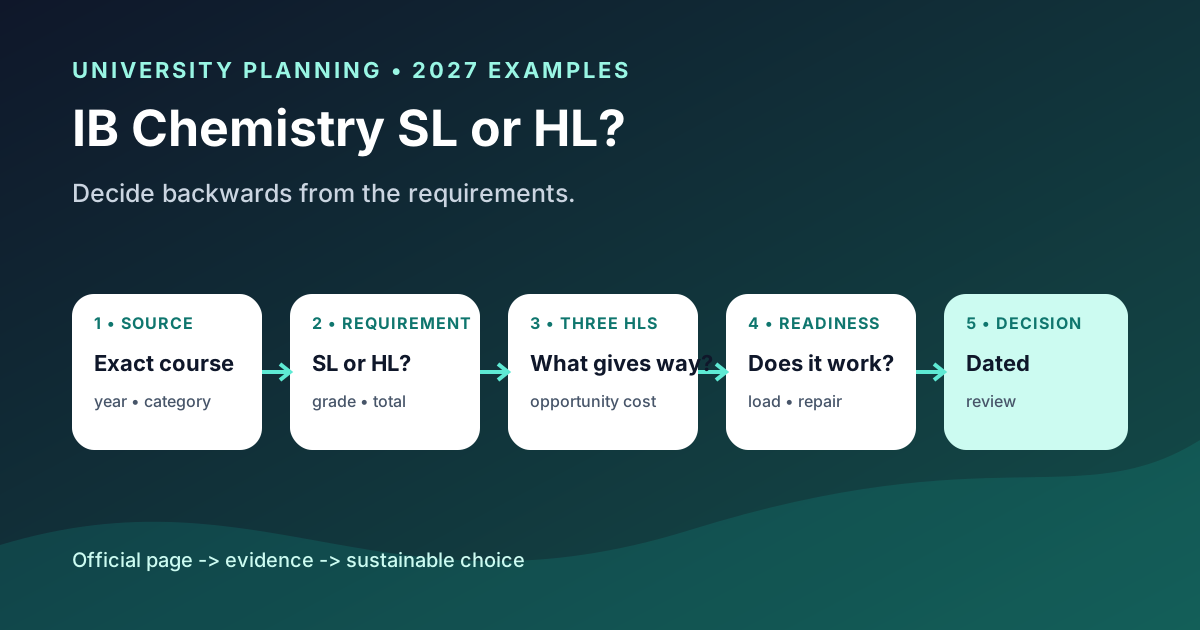
The IB Chemistry SL or HL decision should come from evidence, not subject prestige. A strong choice protects a realistic university route, fits the other two HL subjects and remains sustainable across the complete Diploma.
Maintenance note: the university examples were checked on 21 August 2026 against official sources for 2027 entry or the current cycle available on that date. Admission requirements change. Every family must recheck the correct intake, applicant category and exact course on its official page.
The decision in one minute
Work in this order:
- Requirements: does any realistic course require or explicitly prefer Chemistry HL?
- Realistic degree routes: investigate 2–3 genuine options across more than one institution or country, not a single dream course.
- The other two HLs: Chemistry must earn one limited HL position against the student’s other strong subjects.
- Current foundations: chemical explanation, quantitative setup, data reasoning and learning habits.
- Weekly load: is there enough time for other subjects, the core, sleep and correction?
Choose the level backwards from the evidence
- List realistic degree routes and application years.
- Record exact Chemistry, second-science, Mathematics and total-score requirements.
- Compare Chemistry with the other two HL positions.
- Test current foundations and estimate the complete Diploma workload.
- Choose provisionally, save the evidence and set a review date.
Three practical outcomes follow:
- Evidence points towards HL: at least one serious route requires it, and the necessary foundations can realistically be built.
- Evidence points towards SL: likely courses do not require HL, another HL is more strategic and SL supports a more secure overall Diploma.
- Not yet decidable: university evidence or readiness evidence is incomplete. Make a provisional choice, repair specific gaps and set a review date.
If you first need the syllabus and assessment map, read What Is IB Chemistry?.
Three official 2027 examples
These are not university rankings. They show that even Chemistry-intensive degree names do not produce one universal SL/HL rule.
| Institution and course | Published 2027 / current IB requirement | Meaning for Chemistry level | Additional selection |
|---|---|---|---|
| Imperial College London — Medicine MBBS/BSc, 2027 | minimum 38 points, including Biology HL 6 and Chemistry HL 6. The published typical offer is 39, including 6 and 7 in Biology/Chemistry HL in either order. | Chemistry HL is required. SL does not meet the subject minimum. | UCAT and the course’s other selection stages. |
| Monash University — Medical Science and Doctor of Medicine, international direct entry, 2027 | the official 2027 guide states minimum IB 39, with Chemistry SL 5 or HL 4; an English prerequisite also applies. | Chemistry SL is accepted at grade 5; HL 4 also satisfies the Chemistry prerequisite. | Limited places, ISAT and MMI; academic score is one selection component. |
| University of Oxford — Chemistry | 40 including core points. With HL Mathematics: 766 at HL, including Chemistry HL 7 and Mathematics HL 6. With SL Mathematics: 776 at HL, including Chemistry HL 7 and a second HL science 7, plus Mathematics AA SL 7. | Chemistry HL 7 is required in both published routes. | Recheck the precise cycle and deadline on the official page. |
The same “medicine” label therefore hides different Chemistry-level rules: Imperial requires Chemistry HL 6, while the Monash 2027 international direct-entry example permits Chemistry SL 5. Oxford Chemistry combines Chemistry HL with a different subject pattern depending on the Mathematics level.
The central rule is simple: a degree-family name is not an admission requirement. The exact university, course, campus, applicant category and intake year together constitute the evidence.
What should you extract from an official course page?
Do not save only the large headline total score. Record:
- exact course title and code;
- intake year and application deadline;
- total IB score and whether core points are included;
- the Chemistry requirement: SL or HL, minimum grade, required or recommended;
- Biology, Physics, Mathematics or other subject conditions;
- accepted Mathematics route and level;
- admission test, interview, portfolio or language requirement;
- source URL, checked date and next review date.
Applicant category matters too. International, domestic, direct-entry, graduate-entry and foundation routes may differ within the same institution. If your intake page has not yet been published, do not fill the gap with an estimate. Mark it pending and set a date to check again.
Your university requirements matrix
University requirements evidence matrix
| Institution | Exact course | Entry year | Overall IB | Chemistry | Other subjects | Test / interview | Official source + checked date |
|---|---|---|---|---|---|---|---|
Course 1
Course 2
Course 3
Course 4
For the first pass, complete four rows: two ambitious choices, one realistic choice and one safer alternative. Repeated Chemistry prerequisites strengthen the evidence for a level. Divergent requirements make multi-route planning more important.
Save a screenshot or PDF of each checked page because content can change. Keep minimum requirement separate from typical offer, and never treat meeting a minimum as a guarantee of admission.
Five degree families, five different questions
1. Medicine and dentistry
Chemistry and Biology are often required, but level, grade, total score and admission tests vary considerably. Check whether Chemistry HL is explicitly mandatory and which test applies to the applicant category.
2. Chemistry, chemical engineering and materials science
Chemistry HL is often a requirement or powerful preparation. Mathematics level can be equally important. Look beyond “Chemistry required” to the Mathematics, Physics and total-score combination.
3. Biochemistry, biomedical science and life sciences
Some courses require Chemistry HL; others ask for Chemistry or Biology, or both. Similar names may conceal different first-year curricula and prerequisites.
4. Pharmacy, pharmacology and related health sciences
Chemistry is often central, but acceptance of SL and the required grade vary. Check laboratory or Mathematics prerequisites and any professional selection stages.
5. Routes not centred on Chemistry
For economics, law, humanities, computing or many engineering routes, another HL may be a more direct requirement. Chemistry HL is strategic only when it is a genuine strength or interest, or supports several realistic alternative routes.
These families guide research; they do not replace course pages. University decisions must be made at course level, not degree-name level.
Every HL position has an opportunity cost
Diploma students normally take three HL subjects. When Chemistry occupies one position, another subject remains at SL. The right question is not merely “Am I good enough for Chemistry HL?” It is a paired comparison:
- what does Chemistry HL open or prepare the student for;
- what is lost if Mathematics, Biology, Physics, Economics or another subject does not receive that HL position?
Medicine may make Chemistry and Biology HL decisive. A Chemistry degree may centre Chemistry and Mathematics. Computing or economics may make Mathematics HL more strategic when no route requires Chemistry HL.
For every HL candidate, create three columns: official requirement, preparation value, and expected workload plus grade security. Prestige does not need a fourth column.
Test current readiness
| Domain | Evidence pointing towards HL | Repair signal | Next check |
|---|---|---|---|
| Chemical explanation | builds a precise causal chain from structure and particle model | lists keywords but omits the link | compare a fresh pair of unfamiliar molecules |
| Quantitative setup | handles ratio, algebra, units and intermediate quantities independently | cannot start without a memorised equation pattern | use the same skill in another Chemistry context |
| Data reasoning | separates observation, conclusion and limitation | writes generic course knowledge instead of using the data | graph with spread or uncertainty |
| Learning habits | corrects, retries after a delay and completes a transfer problem | only reads the solution or repeats the same error | fresh task after a two-week repair cycle |
One school grade is insufficient. The four-task HL readiness check produces a secure / developing / not-yet-reliable pattern, followed by two weeks of repair and a fresh retest.
A developing domain is not an automatic objection. The more useful evidence is whether targeted feedback produces independent improvement. A persistently unreliable quantitative or learning foundation does, however, indicate extra time that must fit the complete Diploma plan.
Include the complete Diploma workload
Chemistry HL has 240 recommended teaching hours, 90 more than SL, although the real weekly difference depends on school timetable and prior foundation. Account for:
- regular lessons and work across all three HLs;
- the other three SL subjects;
- Extended Essay, Theory of Knowledge and CAS deadlines;
- internal assessments clustering together;
- admission tests, language tests or competitions;
- sleep, sport, travel and buffer time.
A useful capacity test records one real, ordinary week. Do not design an ideal timetable; note when work actually began and ended, which task rolled over, and how much time remained for correction. A plan that works only through late-night catch-up is not sustainable.
Workload warning signs include continuing sleep loss, a backlog lasting more than three weeks, corrections repeatedly skipped, one HL damaging the other two, and every study session becoming emergency relearning. These do not prove that SL is necessary, but they demand a system change.
Do not estimate capacity from one unusually easy or difficult week. Review at least three weeks, including one assessment-heavy period. A sustainable choice protects not only time to complete tasks, but also time for correction and a delayed independent retry.
When the future route is uncertain
Do not attempt to keep every university in the world open. Build three realistic degree families, then find 2–3 courses for each.
For example:
- medicine / health sciences;
- Chemistry / biochemistry / natural science;
- one route not centred on Chemistry.
Look for recurring prerequisites. If six of seven courses require Chemistry HL, that is strong evidence. If only one narrow route requires it, ask how genuine that goal is and what it costs to preserve.
Make a provisional choice, then attach a review date—for example, 15 November 2026. Save this evidence for the review:
- updated university matrix;
- two corrected Chemistry tasks;
- the HL-readiness retest;
- three weeks of actual time logs;
- feedback from the other two HL subjects.
A provisional choice does not hide uncertainty. It manages uncertainty with evidence.
Separate student and parent tasks
The student’s task: complete the readiness check, show the real weekly workload, correct errors and articulate an honest reason for studying Chemistry.
The parent’s task: help organise official sources, observe sustainability and ask about evidence. It is not to mark Chemistry answers or choose from prestige.
The shared task: write the decision and its conditions in separate clauses. For example: “We provisionally choose Chemistry HL because two target courses require it; in November we will review quantitative setup and weekly workload.”
That is more useful than “Let’s try and see”, because it defines in advance what evidence could change the decision.
Frequently asked questions
Does every medicine course require Chemistry HL?
No. Imperial’s 2027 example requires HL 6, while Monash’s 2027 international direct-entry guide states Chemistry SL 5 or HL 4. Always check the exact course and category.
Does HL look better when it is not required?
Universities apply their published conditions. An unnecessary HL is not automatically more valuable than another relevant HL or a stronger overall Diploma result.
Should a student choose HL if a foundation is still developing?
Possibly, when HL serves a real goal, the gap is precisely diagnosed and targeted work produces independent improvement. The repair time must also be included.
What if the student does not yet know the intended degree?
Use three degree families and 2–3 courses per family to find recurring requirements. Make a provisional choice and review it with dated evidence.
How often should requirements be rechecked?
Before subject choice, at finalisation, in every relevant application cycle and before major deadlines. If the correct intake page is not yet available, set a specific date to check again.
ChemistryTutor.vn
Turn the evidence into a defensible level choice
Bring the official requirements, current subject combination and recent Chemistry work to a focused decision discussion.
Discuss the SL/HL decision